By Miriam Izbicki-Wilson
When most people begin researching their family history, they start with local courthouse records, census records, birth certificates, church registers, or genealogy websites. Piece by piece, they uncover the lives of parents, grandparents, and generations that came before them. For descendants of Holocaust survivors, however, genealogy is often a very different journey. The Nazis deliberately destroyed records, erased entire Jewish communities, and murdered families whose stories might otherwise have been passed from one generation to the next.
For me, researching my family’s history begins not with local records but with Holocaust archives and official historical collections. My search often leads me to the Central Database of Shoah Victims’ Names at Yad Vashem, the collections of the United States Holocaust Memorial Museum, the Arolsen Archives, and the archives of the American Jewish Joint Distribution Committee. Unlike many families whose histories can be traced through birth records or census documents, I have had to piece together my grandfather’s life from official documents, immigration records, displaced persons records, transport lists, and the stories passed down through my family. Every new document helps fill another gap, allowing me to reconstruct a life that the Nazis tried to erase from history.
My grandfather, Abraham Izbicki, was one of those survivors.
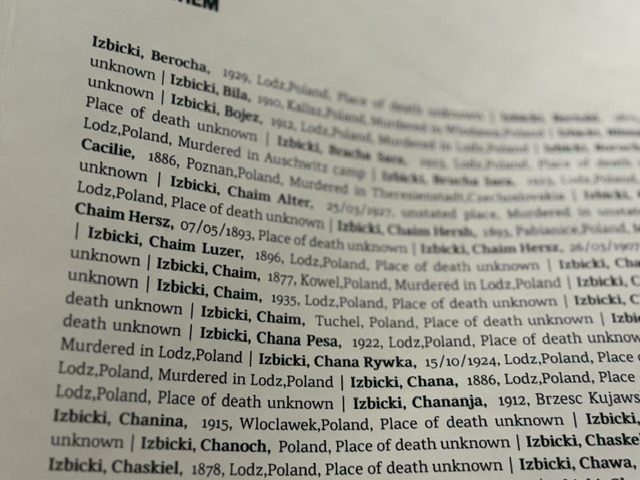
Before the Second World War, he lived in Poland with his wife, children, and extended family. Like millions of European Jews, his life changed forever after Germany invaded Poland in 1939. He was forced into the Łódź Ghetto, where starvation, disease, forced labor, and constant fear became part of everyday life. Eventually, he was deported to Ravensbrück and later transferred to Ebensee, a subcamp of the Mauthausen concentration camp in Austria. In May 1945, American forces liberated Ebensee, ending years of unimaginable suffering.
Liberation, however, did not erase the pain.
My grandfather’s first wife and children were murdered during the Shoah. For a time, he believed that everyone he loved had been killed. Only after the war did he discover that his brother, Samuel, had survived. That discovery gave him one remaining connection to the family he had known before the Holocaust, but it could never replace those who had been lost.
Following liberation, my grandfather spent time recovering in a displaced persons camp in Austria before being transferred to another in the small southern Italian town of Barletta. Like thousands of survivors, he had no home to return to and no clear vision of what his future would hold. Yet despite everything he had endured, he made the courageous decision to begin rebuilding his life.
It was in Barletta that he met my grandmother, Rosa Binneti.
Rosa was twenty-three years old and unmarried, something considered unusual for a woman of her time. She had never learned to read or write because her father believed girls did not need an education. My grandfather, on the other hand, was highly educated and spoke five languages. They came from very different backgrounds, but they shared a common desire to build a future after the devastation of war.
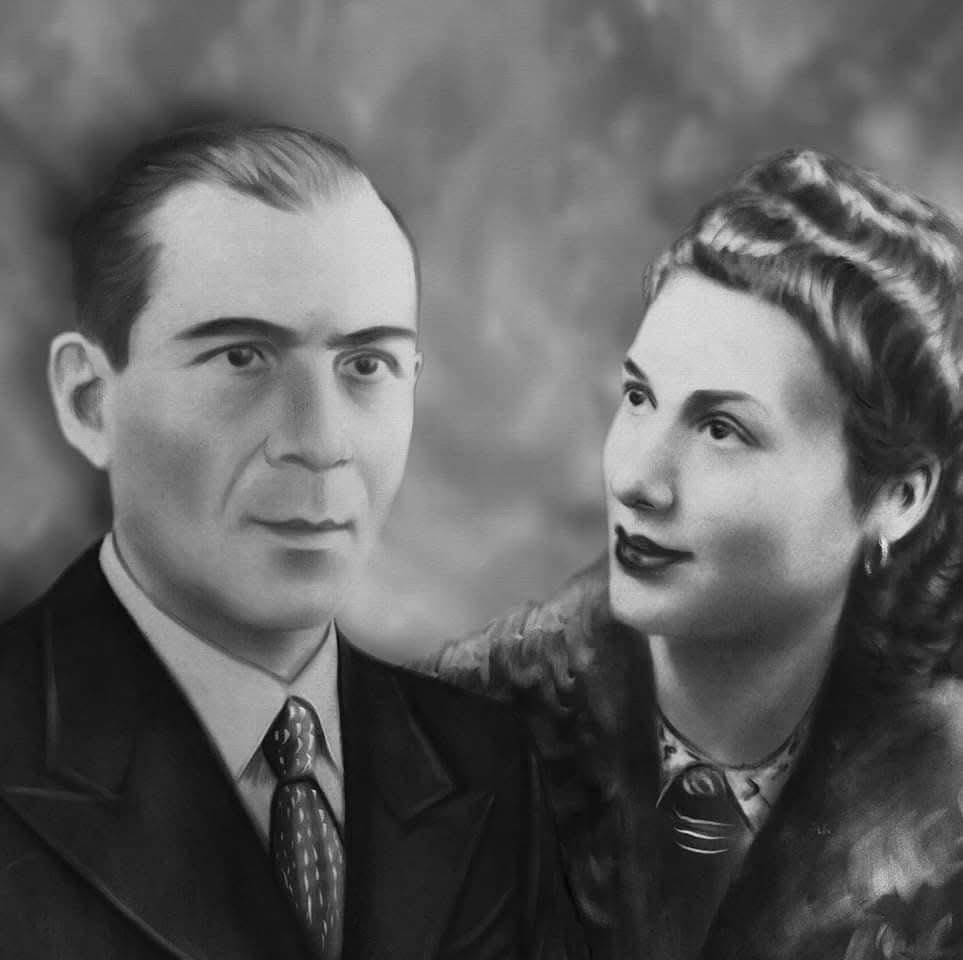
They knew each other for only six weeks before marrying.
What may have begun as a marriage of necessity soon became a lifelong love story. My grandfather wanted to build a family again after losing everything during the Holocaust, and together he and my grandmother created a new beginning from unimaginable loss.
Their first child, my father, Chaim (Hyman) Izbicki, was born in Rome. They later welcomed my aunts, Golda and Lina. In 1956, with sponsorship from the American Jewish Joint Distribution Committee, my grandparents immigrated to the United States. They first settled in Chicago, where my grandfather worked as a tailor before eventually moving the family to Sioux City, Iowa. There they welcomed one more son, my uncle Jack. Both of my grandparents became proud American citizens and remained deeply grateful for the opportunities their new country provided.
Today, when I look at my family, I do not simply see a family tree.
I see the defeat of one of history’s greatest evils.
My grandparents had four children. Those four children became the parents of eleven grandchildren. Today, our family includes twelve great-grandchildren, with future generations still to come. Every birthday, graduation, wedding, holiday celebration, and family photograph is evidence that Hitler failed. His goal was not only to murder Europe’s Jews but also to erase Jewish families, traditions, identities, and future generations. My family’s continued existence is proof that he did not succeed.
As a Ph.D. student studying history, I have come to appreciate that genealogy is about much more than names and dates. For families like mine, it is an act of historical reconstruction. Every archival document located, every transport record discovered, every displaced persons file, and every family story preserved helps restore another piece of my grandfather’s life. My family’s history has been reconstructed by weaving together official records with the memories passed down through generations. Each discovery gives a voice back to people whose identities the Nazis attempted to erase and reminds me that preserving these stories is just as important as uncovering them.
My own research is far from complete. One day, I hope to return to Poland to search local archives, municipal records, and community documents to learn more about my grandfather’s life before the war. I want to discover where he lived, what his family was like, what kind of work he did, and who he was before persecution came to define his life. Every new record I uncover helps restore another chapter of a story that the Nazis tried to erase.
The more I learn, the more I realize that history is not only found in textbooks or museums. It lives within families, preserved through memories, documents, photographs, and the determination of future generations to keep those stories alive. My grandfather survived unimaginable suffering, but survival alone is not his greatest legacy. His greatest legacy is the family he rebuilt after believing he had lost everything.
History often focuses on battles, political leaders, and governments. Yet some of the most powerful stories are found around family dinner tables and in boxes of old photographs and documents waiting to be rediscovered. My grandfather’s story is one of those stories. It deserves to be remembered not only because he survived, but because he chose to live, to love again, and to rebuild.
Every child, grandchild, and great-grandchild in our family is living proof that Hitler did not achieve his ultimate goal. He tried to erase my family from history, but through historical research, archival records, family memories, and the generations that followed, our story continues to be told. That, perhaps, is the greatest victory of all.
American Jewish Joint Distribution Committee Archives. JDC Archives. Accessed July 2, 2026. https://archives.jdc.org
Arolsen Archives: International Center on Nazi Persecution. Arolsen Archives Online Archive. Accessed July 2, 2026. https://arolsen-archives.org/en/
United States Holocaust Memorial Museum. Holocaust Encyclopedia and Collections. Accessed July 2, 2026. https://www.ushmm.org
Yad Vashem. The Central Database of Shoah Victims’ Names. Accessed July 2, 2026. https://collections.yadvashem.org/en/names


Leave a comment