Blog Discussion Thread: Economic Theories of the Great Depression
By Miriam Izbicki-Wilson maizbickiwilson@liberty.edu
Introduction:
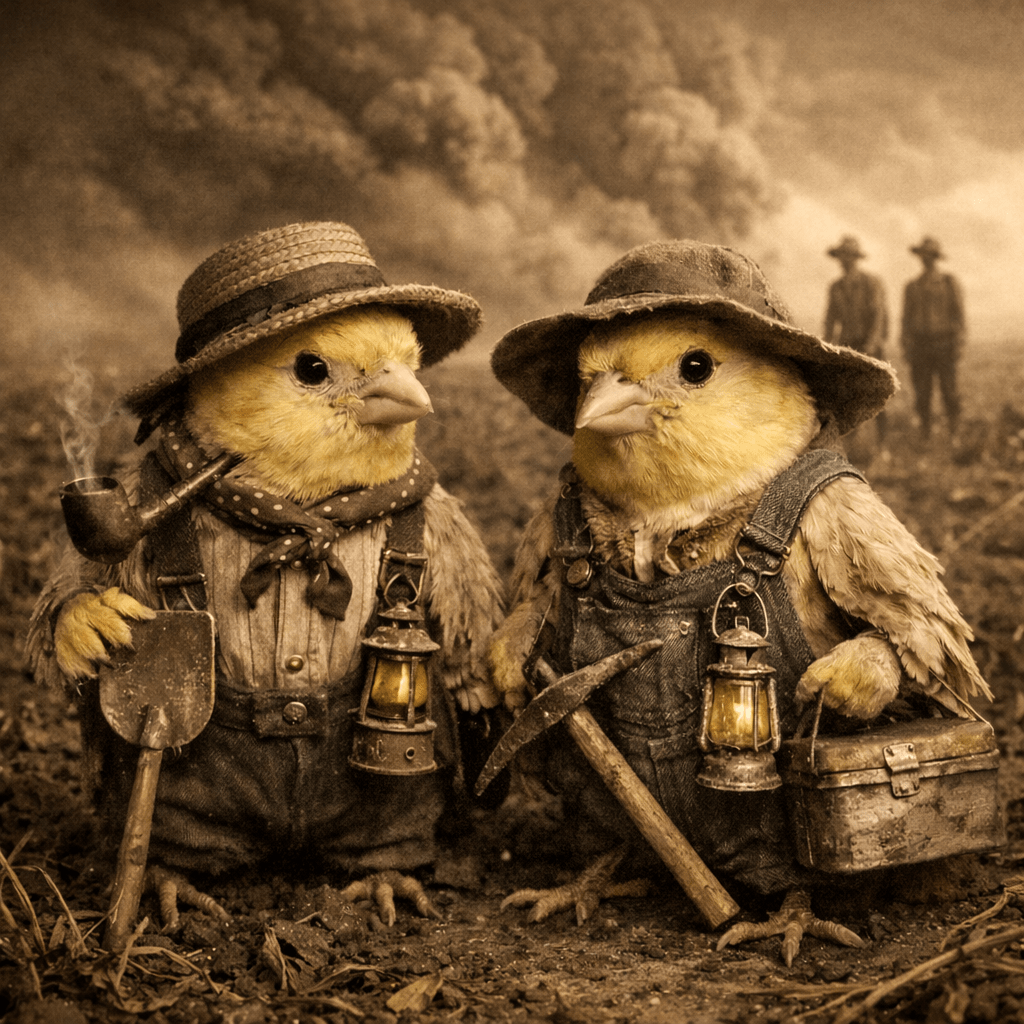
The Great Depression is often introduced through the stock market crash of 1929, but for many farm families, economic disaster had already arrived. During World War I, American farmers were encouraged to produce more food for the global markets. High wartime prices pushed many of them to buy more land, expand production, and take on debt for machinery and equipment. For a brief time, expansion seemed smart. After the war, however, demand fell, prices dropped, and many farmers were left trying to repay loans with shrinking income. This matters because it challenged the common idea that the Depression began suddenly in 1929. In many rural communities, the warning signs were already clear throughout the 1920’s. Farmers saw what happened when prices collapsed, but debts stayed fixed. Their struggle came first, which is why they can be understood as the canary in the coal mine of the American economy. They experienced the pressure of the depression before the rest of the country fully recognized what was coming.
Research Approach: Why These Sources Matter:
This blog uses both primary and secondary sources to explain the relationship between rural hardship and the broader Great Depression. The primary sources include Irving Fisher’s writings on debt deflation, Franklin Roosevelt’s message supporting the AAA, and historical materials on the Dust Bowl. The Sources are helpful because they reveal how people at the time understood both the crisis and the possible solutions. Fisher explains the economic logic of falling prices and rising debt burdens. Roosevelt shows how policymakers linked agricultural recovery to the nation’s recovery. Dust Bowl sources provide direct evidence of how environmental disaster deepened economic pain.
Debt-Deflation and the Farmer’s Burden
The economic theory that best explains the cross is the debt-deflation theory. Irving Fisher argued that when prices fall, debt becomes harder to repay because the money owed stays the same while the debtor’s income and assets lose value. In other words, deflation makes old debts feel heavier. This theory fits farmers especially well because many of them borrow during the wartime boom, expecting strong prices to continue.
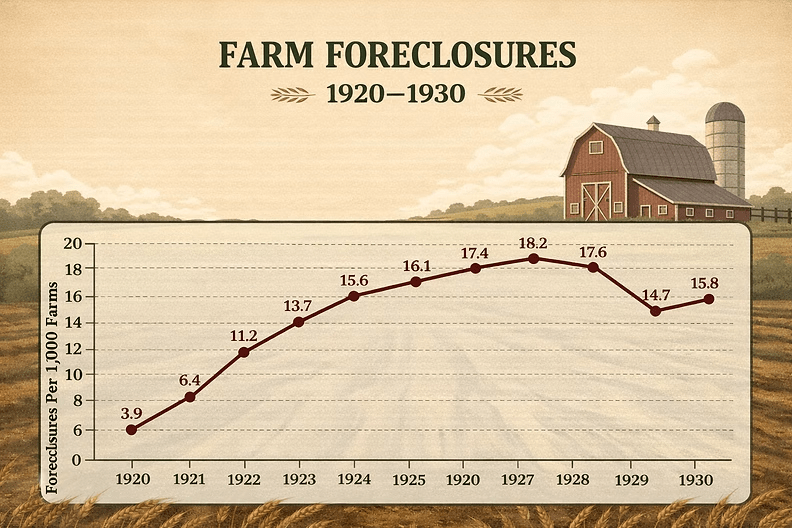
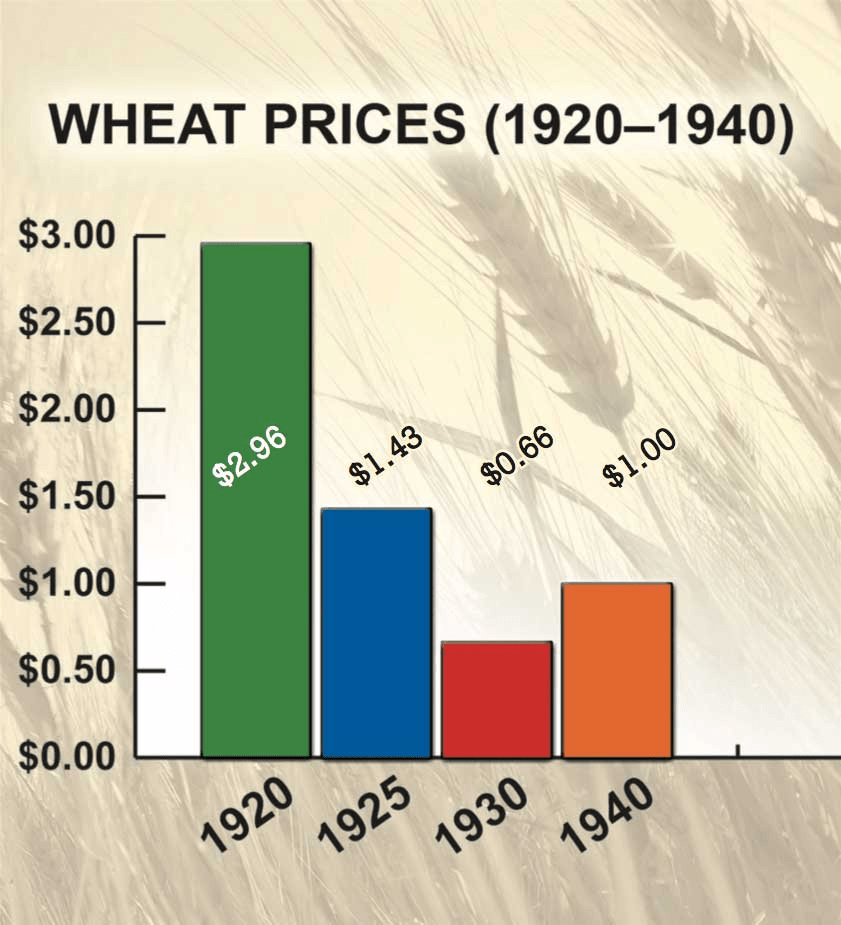
When crop prices fell in the early 192s, farmers were trapped. Their products brought in less money, but their loans, mortgages, and taxes did not shrink in the same way. Land values also dropped, which meant farmers had less collateral and fewer refinancing options. As a result, many farm families faced foreclosure, bank pressure, and long-term insecurity years before the stock market crash shook the rest of the country.
This is why the farmer’s story is so important to understanding the Great Depression. The agricultural crisis revealed a pattern that would later spread more broadly: falling prices, reduced purchasing power, deep debt burdens, and economic contraction. Farmers were not just one suffering group among many. Their condition exposed how fragile the larger economy could become when credit, falling prices, and weak demand collided.
Why Farmers are the “Canary in the Coal Mine”
The phrase “the canary in the coal mine” fits because farmers felt the financial strain before much of the rest of the population did. During the 1920s, many Americans still associated the decade with prosperity, consumer goods, and urban growth. But rural America told a different story. Farmers were already dealing with declining incomes and unstable credit. Local banks that depended on agriculture also became more valuable, especially in farming regions. That meant rural trouble was often an early warning of wider instability.
This early suffering also mattered because farmers were deeply connected to the rest of the economy. When farm families lost income, they bought less. When they could not repay loans, banks weakened. When land values collapse, entire communities lose wealth and confidence. Agricultural distress was never just a farm problem. It was part of a larger economic chain reaction.
In that way, farmers did not simply suffer through the depression. They signed the arrival. Their experience showed what happens when economic systems become overextended and lose the price support needed to keep debt manageable, a trend that affected all businesses during the Great Depression.
Conclusion: The Warning Came from the Countryside.
The Great Depression did not begin for all Americans at the same moment. For farmers, it began much earlier. Long before the famous crash in 1929, rural families were already struggling with low prices, heavy debts, weak banks, and declining land values. Debt-deflation theory helps explain why their hardship was so severe and why it spread outward into the larger economy. Then, the Dust Bowl times only got worse for the American farmer.
Seeing farmers as the canary in the coal mine offers a clear way to understand the Depression. Their struggle was not a side story; it was one of the first and clearest warnings that something in the American economy had gone terribly wrong. Their recovery also mattered because it helped show that the nation’s recovery required more n than just restoring confidence on Wall Street. It required a stable environment and purchasing power in the countryside as well.
Biblography
Alston, Lee J. “The Economics of the Great Depression.” In The Reinterpretation of American Economic History, edited by Robert W. Fogel and Stanley L. Engerman, 315–342. New York: Harper & Row, 1971. Reprinted 1983.
Fisher, Irving. “The Debt-Deflation Theory of Great Depressions.” Econometrica 1, no. 4 (October 1933): 337–357.
Rajan, Raghuram, and Rodney Ramcharan. “The Boom and Bust in Farm Land Prices in the United States in the 1920s.” American Economic Review 105, no. 5 (2015): 143–147.
Roosevelt, Franklin D. “Message to Congress on the Agricultural Adjustment Act.” April 3, 1933. The American Presidency Project. University of California, Santa Barbara.
The Economic History Association. “The Dust Bowl.” EH.net.
The Economic History Association. “The U.S. Economy in the 1920s.” EH.net.
Library of Congress. “The Dust Bowl.” U.S. History Primary Source Timeline.
 Musings with Wilson
Leave a comment